


1. What is a Greenhouse Gas Inventory?
Pursuant to the Law on Environmental Protection No. 72/2020/QH14 and Decree No. 06/2022/ND-CP on the reduction of greenhouse gas emissions and the protection of the ozone layer, conducting a GHG inventory is a critical step in ensuring emission mitigation.
A Greenhouse Gas (GHG) Inventory is the process of collecting, processing, and reporting data related to the amount of GHG emitted from various sources within a specific period for a project, a business activity, or a nation.
The purpose of a GHG inventory is to assess and monitor emissions, helping organizations, businesses, and nations identify primary emission sources, track changes over time, and devise effective mitigation measures.
2. Which Entities Must Implement GHG Emission Reduction?
According to Article 5 of Decree 06/2022/ND-CP, the entities required to implement GHG emission reduction include:
-
Facilities listed in the sectors and establishments emitting greenhouse gases that must conduct a GHG inventory as promulgated by the Prime Minister.
-
Line Ministries managing sectors such as energy, agriculture, land use and forestry, waste management, and industrial processes, specifically: the Ministry of Industry and Trade; Ministry of Transport; Ministry of Agriculture and Rural Development; Ministry of Natural Resources and Environment; and Ministry of Construction.
-
Organizations and individuals not included in the mandatory list are encouraged to implement GHG emission reductions in accordance with their specific conditions and activities.
3. Which Facilities Must Conduct a GHG Inventory?
According to Article 6 of Decree 06/2022/ND-CP, facilities required to conduct a GHG inventory are those with annual emissions of 3,000 tonnes of $CO_2$ equivalent or more, or those falling into the following categories:
-
Thermal power plants and industrial production facilities with total annual energy consumption of 1,000 tonnes of oil equivalent (TOE) or more.
Freight transport companies with total annual fuel consumption of 1,000 TOE or more.
- Commercial buildings with total annual energy consumption of 1,000 TOE or more.
-
Solid waste treatment facilities with an annual operating capacity of 65,000 tonnes or more.
4. Sectors Subject to GHG Inventory in 2024
According to Decision No. 01/2022/QD-TTg issued by the Prime Minister on January 18, 2022, the list of sectors and facilities subject to GHG inventory includes:
-
Sectors listed in Appendix I of the Decision.
-
Facilities under the Ministry of Industry and Trade (Appendix II).
-
Facilities under the Ministry of Transport (Appendix III).
-
Facilities under the Ministry of Construction (Appendix IV).
-
Facilities under the Ministry of Natural Resources and Environment (Appendix V).
Currently, there are 1,912 facilities required to conduct a GHG inventory, with 1,662 under the management of the Ministry of Industry and Trade. These are high-emission facilities across all sectors that are strictly managed to achieve mitigation targets under the Nationally Determined Contribution (NDC) by 2030.
5. Reporting Timeline and Procedures
Under Decree 06/2022/ND-CP, listed facilities must provide activity data and relevant information for the previous year’s inventory to their respective line ministries before March 31 annually (starting from 2023). This includes data on energy consumption, types and quantities of GHGs emitted, and other information to ensure accuracy.
Starting from 2025, enterprises must conduct a GHG inventory every two years and submit reports to the Provincial People’s Committee before March 31. The Ministry of Natural Resources and Environment will coordinate with line ministries and Provincial People’s Committees to review and update the list of facilities, submitting it to the Prime Minister for decision every two years.
Conclusion
Identifying and inventorying GHG emission sources in Vietnam is a vital part of the National Strategy on Climate Change. It is not only a legal requirement but also a corporate responsibility toward environmental protection.
INSTITUTE OF SCIENCE AND INNOVATION (IOSIN)
Insight – Partnership – Growth
- Address: No. 15 LK20A Van Phu Urban Area, Kien Hung Ward, Ha Dong District, Hanoi.
- Contact: 0905.423.748 – 024.32 123 140
- E-mail: info@iosin.org
- Website: https://iosin.org
Related Articles

ANNOUNCEMENT: LUNAR NEW YEAR BREAK 2026 (YEAR OF THE HORSE)
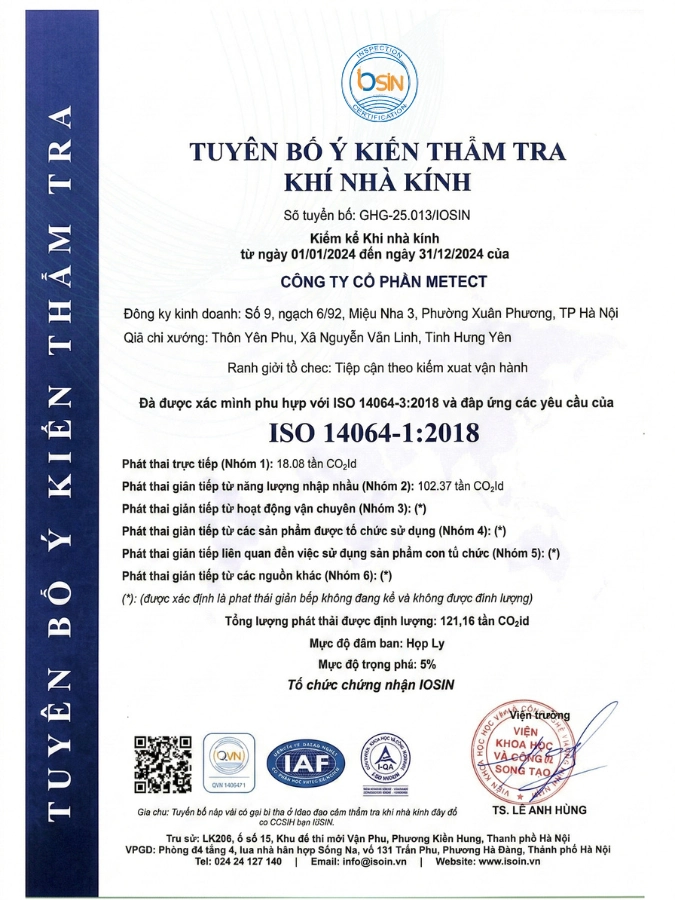
ISO 14064-1:2018 Success: IOSIN supports METECT in GHG Inventory Certification

ISO 9001:2015 Certification Audit Process

Regulations on the use of Marks

GHG Validation and Verification Process
